Clive Petrovic
consider Clive Petrovic a friend and a friend of the environment. Clive wrote environmental impact statements (EISs) for developments in the territory and managed the project in the mangroves below.
"Mr. Petrovic, who is the former Head of Marine Studies at the H. Lavity Stoutt Community College will serve as a mentor and is responsible for overseeing the implementation of the Project Environmental Management Plan (EMP) and the day-to-day activities related to the environmental aspects of all RDA programmes and projects. He brings almost 40 years’ experience to the post and has conducted impact assessments and environmental impact reports for several projects in the Virgin Islands’ both in the public and private sector.
Mr. Petrovic served in the posts of Lecturer and Principal Lecturer at the H. Lavity Stoutt Community College and as Adjunct Professor of Biology at the Florida International University. He is an entrepreneur and has worked on the US mainland, in Ecuador and the Bahamas.
He attained both a Bachelor and a Master’s degree in Zoology from the Ohio State University and is a recipient of the U.S. Fish & Wildlife Service Graduate Fellowship." (1) Read more at CLIVE PETROVIC TAKES UP APPOINTMENT AS ENVIRONMENTAL SPECIALIST at the Virgin Islands (UK).
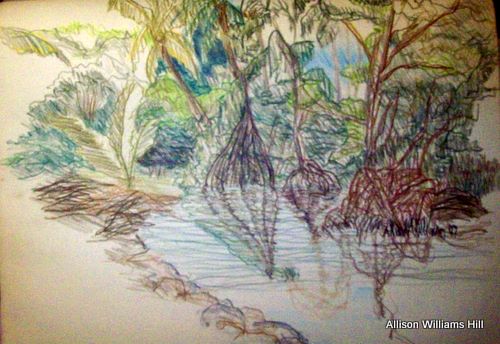
CGB (Cane Garden Bay) Mangroves by Allison L. Williams Hill
The
BVI government asked Clive, environmentalist, marine biologist and
scuba diver instructor, to create the marine studies curriculum for H.
Lavity Stoutt Community College. In 1993, he became the head of the
Centre for Applied Marine Studies department for twelve years. Clive
created a conference at HLSCC that included recognized scientists such
as Jean Michel Cousteau.
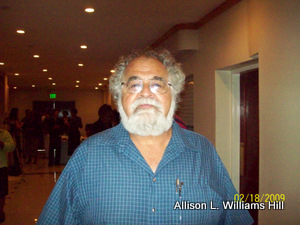
Black Hat Sect feng shui uses "cures" to improve negative situations. One of the areas of the bagua is called "Helpful Friends, Earth Angels." It is located, in relation to the door or entry, in the far right corner of a space or area. Placing objects in this area and using the power of intention, strengthens energy for the presence of loving, caring people. Clive Petrovic, one who should be in that area in picture or object), is a friend of all bodies of water and all that lives within them.
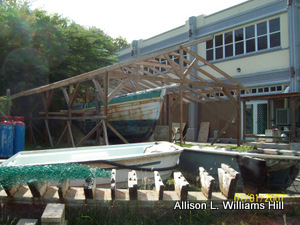
I met Clive at the H.L.S. Community College. The Applied Marine Biology Building pictured here is adjacent to the boardwalk project he developed that takes one through Paraquita Bay Lagoon's mangrove ecosystem, home to a fascinating environment of terrestrial and marine wildlife.
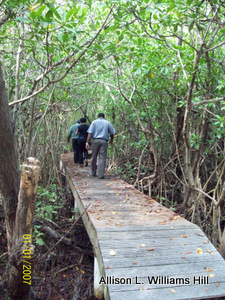
Clive Petrovic and the The Nature Boardwalk
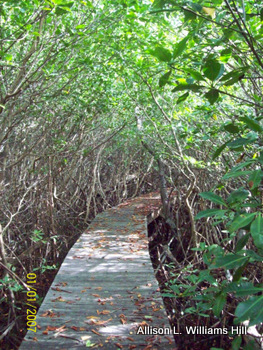
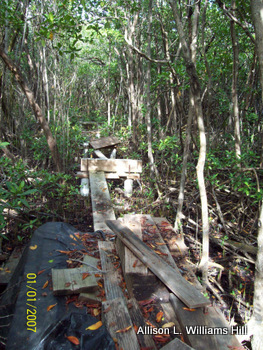
The nature boardwalk through the mangroves brings you up close and personal to what I call the forefront defense against hurricane force winds.
While working on the college's master plan, I learned from Dr. Lianna Jarecki that mangroves provide protection for spawning fish from predators allowing BV Islanders to support their diet with such varieties as Old Wife, Nurse, Parrot, Hard Nose, and Doctor fish.
The fishermen harvested these fish and more for generations. there was a moratorium on certain areas. Clive shared with me the fishermen did not understand why. the numbers were depleted, he explained, because equipment is better and ways of preserving fish, such as freezing, is available. The moratorium wasin place to allow the population to increase and provide fish for the fishermen's businesses.
To be continued...
The environment and its participants work in an integrated process, a cycle. It is the humans that remove the particpants of the life process of the mangrove and consumes them. They do not consume each other. They serve the whole.
Crabs eat the fallen mangrove leaves for the tannin which is harmless them. Their waste is changed by the bacteria into nutrients. The nutrients are carried by the tide to animals that eat it, namely algae and coral.
Crab mortality has diminished. In November 2003, a tropical storm event left several areas of Tortola under 6 feet of water. This system brought rain only, no hurricane force winds. It took 4 hours to reach the college from the Administration Complex which usually takes 10 minutes. Later, culverts were constructed to improve drainage from the land to the lagoon. The crabs, thankfully, began using the culverts instead of crossing Blackburne Highway. There was a feeling in my heart as if it were wrung out when I witnessed or heard reactions to pain. That was what I felt when I saw the road littered with broken crabs that were crushed under tires.
It is a wildlife habitat for several species of birds, some of which are migratory, that nest among the branches.
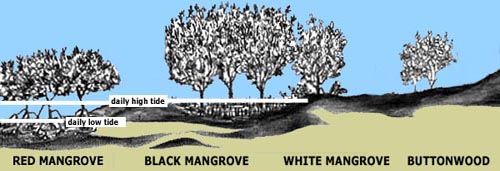
A Little About Mangroves
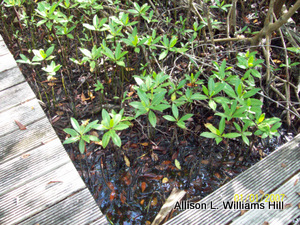
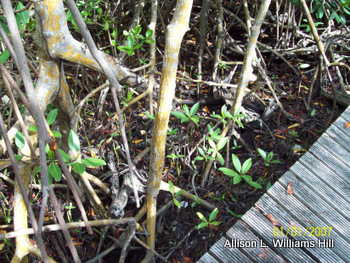
Four types of mangroves have recognizable differences.
Red Mangroves (Rhizophora mangle)have tangled, reddish roots. Technically prop roots extend three feet or more above the surface of the soil, They increase stability of the tree supply oxygen to the underground roots. Red mangroves can grow as tall as thirty feet.
A dedicated marine biologist showed us at the Town and Country Planning Department what a red mangrove individual looked like. It reminded me of a locust seed pod but was thin. It was planted in a split plastic tube as part of the mangrove restoration program. As the seedling grows, it requirement for protection and support from its "cocoon" reduces. The split allows for expansion and it ultimately breaks away. Typically, seedlings germinate while still attached to the tree and remain there to ensure its survival. Others may be carried to other locations by the currents.
Black Mangroves, or Avicennia germinans, have long horizontal roots and pneumatophores. Its roots are exposed to air. The root system can be easily identified because of hollow tube that allow oxygen to get to underground roots. These can grow to over sixty five feet, more than twice as high as red mangroves. Black mangroves have dark, scaly bark and produce white flowers. Seedlings also germinate while still attached to the parent tree enabling higher survival rates.
White Mangroves have a different root system. They grow in soil up to fifty feet. It has broad, flat yellow-green leaves and produce geen-white flowers.
Buttonwood mangroves got their name from the button-like appearance of the dense greenish flower heads that form cone-like fruits. Buttonwoods produce seed cases.
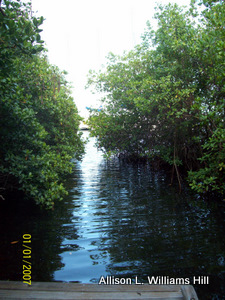
The lagoon is located at the base of an alluvium that collects some of the 3 million gallons of runoff from a watershed of approximately 800 acres. Paraquita Bay has the richest soil for food production, the reason the HLS Community College is located there, to perpetuate agriculture.
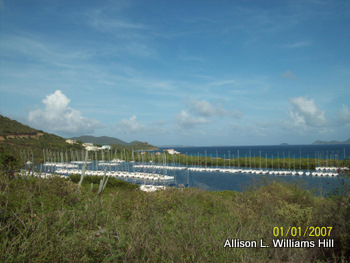
Above is a view of the lagoon, a designated hurricane shelter for marine vessels, managed by the Department of Disaster Management.
Thanks, Clive for creating this access into a least known part of the islands. This is a beautiful and tranquil living classroom with so much to learn about and to understand.
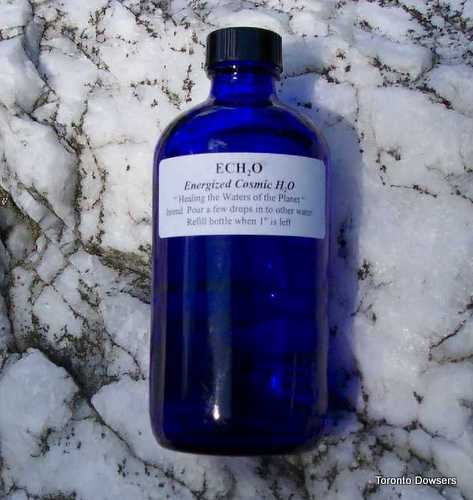
About Water
The Healing Water project withECH2O, water energized through prayer, was started with blessed water I ordered from the Toronto Dowsers, CA began in the British Virgin Islands. Traveling on ferries and boats with the (then) Conservation and Fisheries Department provided the opportunity to use the ECH2O. The British Virgin Islands map shows the path where I dropped Healing Water in the vessels' wakes. I flicked drops in the wakes of the boats and when the boat was standing, I dropped a few more. The prayers in the ECH2O continuously do their work and spread, carried by the currents, across and down.
I did not include that I drank it. The human body is 70% water. Visualize what this can do for it. Dr. Masaru Imoto's work thankfully reached world-wide distribution before he died. His work involved speaking words to water and freezing water molecules revealing patterns of energy from spoken words. The movie "What the Bleep Do We Know?" asked the question: If the energy of words do that to water, imagine what they do to us?
What would programmed water do for mangroves?
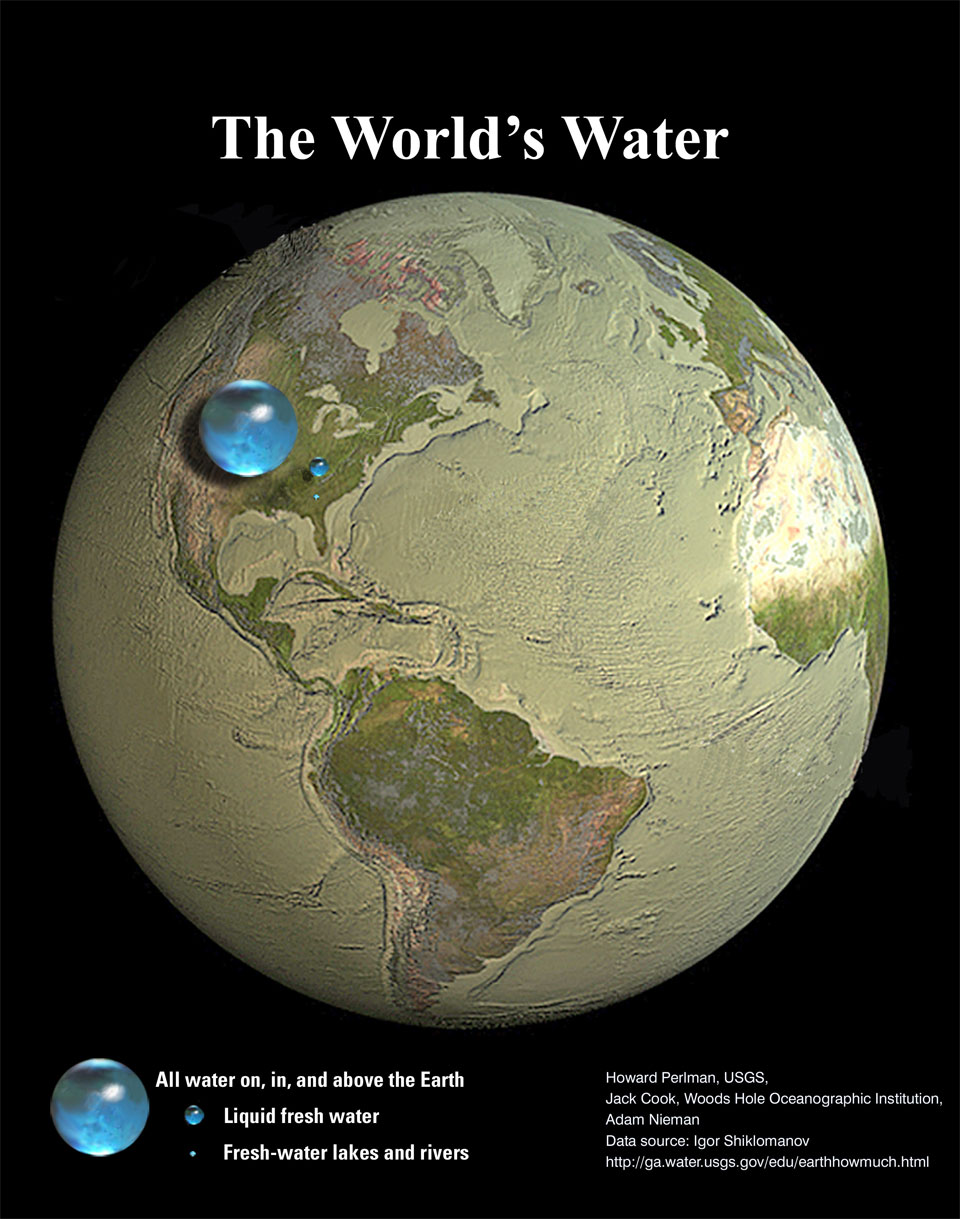
From Woods Hole Oceanographic Institution (WHOI):
"Viewed from outer space, Earth has been called the Blue Planet. But if you could pull all the water in the ocean, the atmosphere, groundwater and surface water into a ball, it would measure only about 950 miles (1,500 kilometers) in diameter (the large sphere) Only about 3 percent of the world’s water is fresh (the mid-sized sphere); and of that, only one-third is easily accessible to humans (the small sphere). (Illustration by Jack Cook, © Woods Hole Oceanographic Institution)"
That is a startling image. The Earth, without its blue waters, the total content of this resource is shown as the large ball of water.
The second large ball is world's fresh water.
The third ball is what is available to hydrate all living things on this planet.
Would this help people to realize how rare our life-giving recource is?
Are our actions in the last twenty years, keeping in mind how Raytheon and others have engaged in weather engineering to cool the planet, reflecting that concern?
The non-like supporting elements that fall into the water contradict it.
Related Pages
Water, Energy, Nature and Humans
Herbs of the British Virgin Islands
Footnotes
1 CLIVE PETROVIC TAKES UP APPOINTMENT AS ENVIRONMENTAL SPECIALIST at the Virgin Islands (UK)
2 The Earth’s water supply in perspective
Resources
The Earth’s water supply in perspective
Woods Hole Oceanographic Institution (WHOI)
Links