Dead Whales

his article is Dead Whales Click Bait has the title “Scientists finally figure out why hundreds of gray whales keep washing up dead along US coasts.” Written by Sascha Pare, it is a great title, all positive. It gave me the impression that, as one concerned for the Co-Creators, I would read what caused their deaths. Nothing could have been farther from the truth.
First paragraph: “A strange series of mass deaths among gray whales in the northeastern Pacific Ocean may finally have an explanation, with scientists linking Arctic sea ice levels to the major die-off events.” “…may finally have an explanation”? Another paragraph: “Unlike the two previous events, a historic loss of Arctic sea ice could be to blame for the latest gray whale die-off.” Could be the blame? “Climate change might be the reason this mortality event is dragging on for longer than the previous two...” Might be?
Might be?
The title of the article was misleading. They may have an idea, however, Save the Whales superseded this
filler in documenting what affects our marine friends.
In addition to providing the link to the article, it is copied in its entirety below. A disappointment about the internet is that content disappears and links become useless.
At https://savethewhales.org/whales-wind-farms/ Save the Whales.org revealed a different situation. “Concerns By Save The Whales and Partner Organizations on Wind Farm Proposals” identified issues regarding a wind farm power plant proposal and its impact on right whales.
It is disturbing that this information was not publicized on mainstream media. Save the Whales listed considerable concerns about what are directly affecting whales. The Mayflower Wind energy farm, south of Martha’s Vineyard is the array of blade turbines (already known to endanger birds, yet they are erecting them) that “…is expected to generate enough electricity at a cost as low as 5.8 US cents per kilowatt-hours (KWh) for approximately 680,000 households a year.” (Mayflower Wind Farm, https://www.nsenergybusiness.com/projects/mayflower-wind-farm/).

"Ascension" by Allison L. Williams Hill

Chakra -3 by Allison L. Williams Hill
They owners should make a significant profit. It is tiring to read content slanted to appear to benefit users.
In a list, their response includes:
1. There is insufficient data that does not support the claimed tonnage of carbon dioxide emissions spared annually of the project;
2. Metal and concrete surface area in the marine environment; The installation of reinforced concrete may impact marine animals’ ability to use sound for navigation.
3. the project represented a threat to the continued existence of the North Atlantic Right Whale.
4. the effects of sounds generated by the arrays impacting marine animals that depend on sound may be detrimental.
This ties to number 2. Driving piles on land affect people. They may get headaches, however, the sound waves pass through fluids and the body have 70% of it. The effects of pile driving have never been studied. It is likely not promoted as an illness because on one has been able to figure out how to make money from it.

Thought detail 5 by Allison L. Williams Hill
5. We also found examination of effects on migratory birds in the DEIS to be inadequate. Many birds use infrasound for essential migration timing, ensuring that energy expenditure does not exceed energy reserves, and that deadly storms are avoided. Insufficient studies regarding migratory birds and the impact of blade arrays. It is evident that birds have been killed by the blades which is why organizations are encouraging bladeless wind turbines. The installation of blade turbines makes this array look antiquated.
Wind turbine structures are enormous and have considerable weight. I look at these structures like buildings. Piles are driven to find rock, a stable foundation. I should think the same process is used underwater. There are different conditions, depending on water depth, however, water forces
All About Offshore Wind Turbine Foundations delineates several conditions to install wind turbines. Since reading this, bladeless wind turbines are being installed. Recently painting one of the blades of a standard wind turbine reduced bird mortality. The information did not provide a percentage of lives saved.
It was the burden of the developer to know the harms of developing and to implement measures to minimize or eliminate the problems that develop from changing the environment.
Rob Brand – noise studies
Deaths NY and NJ offshore- correlation
350 whales – minke, humpbacks, North Atlantic died since 2016
Mapping land underwater for projects
It appears that Environmental Impact Studies (EIS) are not required.
Precautions are not the problem of the developer anymore. Shift towards climate change so the natural environment to satisfy that need is being compromised.
Public at large the environmental movement priority was to protect wildlife and stopped pipelines, power plants from being built. But not the offshore, renewable energy situation. Environmentalists are not supporting the marine life communities.
Investigating the money trail -taking money from the concerns disrupting the marine environment for profit.
Networks of organizations – investigation of deaths
Just like with people - women trafficking for sex on and, now we know, off the planet. Trafficking children for sex, organs, creating adrenochrome - what else?
Members are taking money from the businesses they should be monitoring
Atlantic Marine Conservation Society- examining humpback whale that washed ashore
2020-21 change in board of directors president Paul Tanna lobbyist for Ecquanor - a wind developer
Sammy Chu- distributor energy developer
Jennifer Dupont – environmental affairs- advocate for Ecwuanor before federal and state government
Some whales are endangered. Less than 350 North Atlantic Right whales live on the planet. When 2 died and a proportion is set up between humans and whales, the human equivalent was 16.5 million people.
Wave effect of the turbines affecting the plankton that the whales need. Destroying the plankton ushers them to extinction.
Buffer areas to protect the right whale.

On January 18, 2024, Gary Null played a part of Michael Shellenberger’s video called “Michael Shellenberger’s Guide to Escaping the Woke Matrix .”
That was quite informative. In the right side at Youtube, The Hill had an interview with Mr. Shellenberger
I was taking my time to complete a blog called “Dead Whales Click Bait” and was beating myself for taking too long to complete it.
I began it after seeing a Google article on my phone called "Scientists finally figure out why hundreds of gray whales keep washing up dead along US coasts."
This reminds me of the bad foam that rises to the top of industrial waste deposited into a river teeming with life.
The Dead Whale Click Bait Article
Scientists finally figure out why hundreds of gray whales keep washing up dead along US coasts https://www.livescience.com/animals/whales/scientists-finally-figure-out-why-hundreds-of-gray-whales-keep-washing-up-dead-along-us-coasts
News
By Sascha Pare
published October 17, 2023
Three mass mortality events have struck a population of gray whales off the west coast of North America since the 1980s, and scientists have linked them to changing conditions in the Arctic.
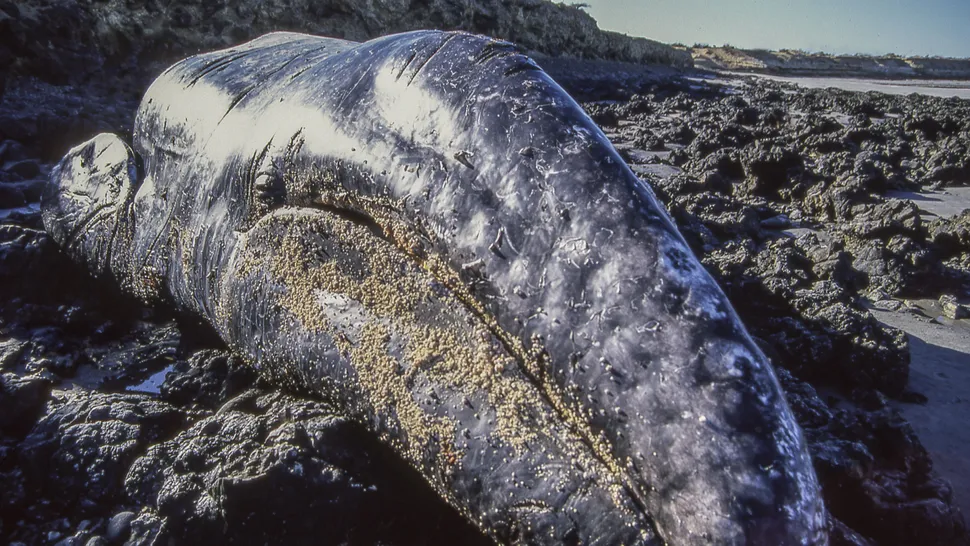
A dead grey whale (Eschrichtius robustus) on the beach near the town of San Juanico in Baja California Sur, Mexico. (Image credit: CampPhoto via Getty Images)
A strange series of mass deaths among gray whales in the northeastern Pacific Ocean may finally have an explanation, with scientists linking Arctic sea ice levels to the major die-off events.
Three mortality events have struck gray whales (Eschrichtius robustus) living off the coast of North America since the 1980s, reducing the population by 15% to 25% each time, according to a new study. In total, more than 2,000 gray whales are known to have died. The first mass die-off took place between 1987 and 1989 and was the largest in magnitude, killing at least 700 whales. Reporting structures and survey efforts only expanded in the 1990s, however, meaning the number of strandings associated with this mortality event could be an underestimate, according to the study. The second took place between 1999 and 2000, killing 651 whales.
The latest die-off began in 2019 and saw more than 70 gray whales wash up dead in just six months. It is ongoing and — as of Sept. 26, 2023 — a total of 688 whales have died. What caused each of the events was unclear.
"These are extreme population swings that we did not expect to see in a large, long-lived species like gray whales," study lead author Joshua Stewart, an assistant professor at Oregon State University's Marine Mammal Institute, said in a statement.
Commercial whaling until the mid-20th century drove the population of North Pacific gray whales to near-extinction, but it has since bounced back and currently numbers around 14,500 individuals, according to the statement. Scientists previously thought this successful recovery meant the whales were dying off periodically as their numbers exceeded what their habitat and prey could provide for.
But changing conditions and fluctuating sea ice levels in the Arctic may better explain what the National Oceanic and Atmospheric Administration (NOAA) termed "unusual mortality events," according to the new study, published Oct. 12 in the journal Science.
Sea ice cover and the amount of food available for gray whales may dictate how the population fares. Higher-than-usual ice cover in some years may block passage to the Bering and Chukchi seas, where the whales spend the summer months feasting on fatty crustaceans before migrating southward again. "When the availability of their prey in the Arctic is low and the whales cannot reach their feeding areas because of sea ice, the gray whale population experiences rapid and major shocks," Stewart said.
Gray whales quickly rebounded from the first two mortality events. But the most recent die-off is ongoing since 2019 and has cast us into "uncharted territory," Stewart said.
Unlike the two previous events, a historic loss of Arctic sea ice could be to blame for the latest gray whale die-off. That's because sea ice hosts a carpet of algae on its underside, which decays and showers the seabed with food for bottom-dwellers, including the whales' preferred crustaceans.
"With less ice, you get less algae, which is worse for the gray whale prey," Stewart said. Melting sea ice also frees up passage for strong currents that sweep away the sediment and leaves bottom-dwelling crustaceans and other creatures homeless. "All of these factors are converging to reduce the quality and availability of the food [gray whales] rely on," he said.
Climate change might be the reason this mortality event is dragging on for longer than the previous two, Stewart said. "What we're seeing is much more of a bumpy ride in response to highly variable and rapidly changing ocean conditions," he said.
While climate change could mean there is less food for gray whales, it probably won't put the northeastern Pacific population at risk of extinction, Stewart said. But "an Arctic Ocean that has warmed significantly may not be able to support 25,000 gray whales like it has in the recent past," he added.

She by Allison L. Williams Hill
Links